

As I was traveling to Sevierville, Tennessee, to meet with eco-travel expert, Scott King, I noticed this beautiful statue of a black bear. There are efforts all over the Smoky Mountains to protect black bears but yet up north in New York, New Jersey and Pennsylvania, these beings are still hunted. Talk about a difference between the north and the south! We need to stop destroying wildlife habitat. They have a right to be here too!
Bear Facts About Taxonomy
According to the Pennsylvania Game Commission, bears are large-bodied members of the mammalian order Carnivora, family Ursidae that evolved from small tree-climbing ancestors (Miacids) almost 25 million years ago (Herrero 1999). There are eight species of bears worldwide occupying all continents, except Australia, Antarctica, and Africa. Six species that are of relatively recent evolutionary origin belong to the genus Ursus. The other two species, the spectacled bear and giant panda, belong to different genera and are from much older lineages. Three species of bear occur in North America:
- the polar bear (Ursus maritimus),
- the brown or grizzly bear (Ursus arctos),
- and the American black bear (Ursus americanus).
The American black bear is the only species living in Pennsylvania and the eastern United States (Pelton 1982, Servheen 1990). As many as 16 subspecies of the American black bear have been described based on differences in size, distribution and color (Hall 1981). The subspecies typically reported for Pennsylvania is Ursus americanus americanus (Whitaker and Hamilton 1998).
New York State harbors one of the largest bear populations in the eastern United States. The DEC monitors
several indices of the bear populations, such as bear harvest, non-hunting mortality and nuisance complaints to determine population trends. New York bear populations have been increasing in recent years, especially in southern New York.
Bears have traditionally been labeled as one of the slowest reproducing terrestrial mammals in the world (Bunnell and Tait 1981). This assertion is based on the fact that bears do not produce young until several years old, do not produce large litters, and have a relatively long interval between births (e.g., 2–3 years).
![]() Killing Babies and Babies Killing Babies
Killing Babies and Babies Killing Babies

Below is the “harvest information” for New Jersey. This is not only a destruction of God’s creations but a pure demonstration of the state of human consciousness and lack of compassion for other beings that we share this earth with.
Q) Can I shoot a female if it is with cubs?
A) Yes, you are encouraged to shoot the first black bear that presents you with a safe shot that will provide a quick clean kill. This is a management hunt and all year classes, male and female black bears are legal to harvest.
Q) Can I shoot a cub?
A) Yes, any sex or size black bear is legal to shoot.
Q) Can youth hunters hunt black bear?
A) Yes, provided they have a valid Youth Firearm Hunting License, Rifle Permit (if muzzleloader hunting), black bear hunting permit, and if between the ages of 10-13 be accompanied (i.e. under direct supervision at all times) by a properly licensed hunter age 21 or older also in possession of a valid bear permit. Holders of Youth Firearm Licenses age 14 and above are permitted to hunt black bear on their own.
Q) Can I legally shoot a black bear with tags or a radio collar?
A) Yes. If you are successful and harvest a bear with tags or a collar be sure to bring them to the check station with your bear.

To learn about regulations in Pennsylvania click here and Hunting the Black Bear in New York
Facts About Black Bears
Source: Lynn L. Rogers, PhD, Please support Bear.org !
Hollywood and Folklore:
Perhaps no other animals have so excited the human imagination as bears. References to bears are found in ancient and modern literature, folk songs, legends, mythology, children stories, and cartoons. Bears are among the first animals that children learn to recognize. Bear folklore is confusing because it is based on caricatures, with Teddy Bears and the kindly Smoky on one hand and ferocious magazine cover drawings on the other. Dominant themes of our folklore are fear of the unknown and man against nature, and bears have traditionally been portrayed as the villains to support those themes, unfairly demonizing them to the public. A problem for black bears is that literature about bears often does not separate black bears from grizzly bears.
Black Bear Identification:
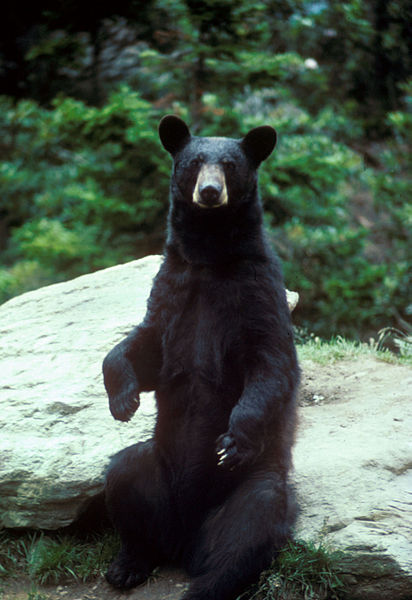
Most people confuse black bears with grizzly bears. The black bear is approximately 4 to 7 feet from nose to tail, and two to three feet high at the withers. It has small eyes, rounded ears, a long snout, a large body, a short tail, and shaggy hair. It differs from grizzly bears in being smaller with a smaller shoulder hump, a furred rear instep, a less concave facial profile, smaller claws that are more tightly curved, and longer, smoother, and more tapered ears.
Parental Care:
Cubs usually stay with their mother for 17 months (rarely 29 months). One to six days before the mothers are ready to mate in late May or June, they force their yearlings to stop traveling with them. This basically means that females reproduce once every two years. At the rate they are being killed and loss of habitat, they will soon be endangered.
Intelligence:
Large brain compared to body size. One of the more intelligent mammals. Navigation ability superior to humans. Excellent long-term memory. Can generalize to the simple concept level.
Sounds:
Usually silent (except in movies in which sounds are dubbed in). A variety of grunts in amiable situations. Loud blowing noises when frightened. Clack teeth when frightened. They use a resonant, humanlike “voice” to express a range of emotions from pleasure to fear. Does not threaten by growling (except in movies). In story-telling, any sound a bear makes is called a growl.
Living with Bears:
Many people are moving into black bear habitat. The bears’ future depends on how well we understand and tolerate them.
Preferred Foods:
Nuts, acorns, fruit, insects, succulent greens. Meat and less succulent greens are eaten when preferred foods are scarce. A scarcity of preferred foods can result in failed reproduction, stunted growth, failure to add optimal amounts of fat, and death of young bears, especially cubs.
Long-Term Problem:
Magazines and movies have given black bears an unrealistically ferocious image, causing people to fear them excessively and kill them unnecessarily. There are many misconceptions about black bears.
Greatest misconception:
The greatest misconception about black bears is that they are likely to attack people in defense of cubs. They are highly unlikely to do this. Black bear researchers often capture screaming cubs in the presence of bluff-charging mothers with no attacks.
Defense of cubs is a grizzly bear trait. About 70 percent of human deaths from grizzly bears are from mothers defending cubs, but black bear mothers have not been known to kill anyone in defense of cubs.
Appalachian Bear Rescue
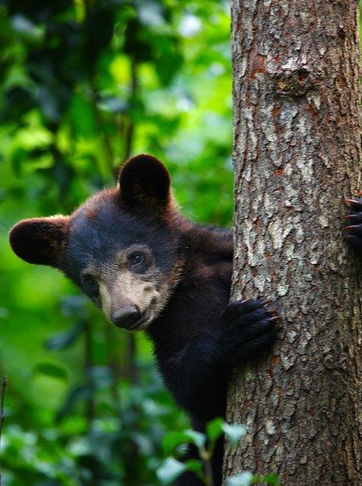
While the slaughter of black bears continues in the north, in the south, the efforts to protect these necessary predators continues. Another great Tennessee organization that provides medical attention for bears is the Appalachian Bear Rescue (ABR). It is a one-of-a-kind black bear rehabilitation facility. Located just outside of the Great Smoky Mountains National Park in Townsend, TN, Appalachian Bear Rescue is a nonprofit, tax-exempt organization that has been returning black bears back to the wild since 1996. Each year black bears from our national parks and surrounding areas are orphaned, injured or in need of medical care. Thanks to Appalachian Bear Rescue, these bears are rehabilitated and released back to the wild.
I do accept as true with all the ideas you’ve introduced on your post. They’re really convincing and will certainly work. Still, the posts are too brief for novices. Could you please lengthen them a bit from next time? Thank you for the post.