In America, the beer industry was ruled by one company for many years. Once Budweiser was no longer king, partially due to the fact that they are no longer an American brand, the microbreweries began popping up all over as beer connoisseurs quickly learned old world beer making techniques. However, it was difficult to find the high quality ingredients needed to make a good brew and there were very limited resources.
In 1996, Seven Bridges was founded by a small group of home brewers to make organic beer more widely available to beer loving consumers in North America. It quickly became evident that the quality, availability and selection of organic ingredients was very limited. So, they set out to change this by first making the few available ingredients accessible to home brewers. Soon after, they started developing recipes along with a line of organic beer kits. This would help the novice brewers to brew a high quality organic beer like the pros.
Seven Bridges also decided that education was a key component to changing the industry. They went the distance by creating awareness as they educated beer lovers about the importance of using high quality organic ingredients in their recipes. This is what significantly impacts the quality of the beer. By doing this, Seven Bridges successfully helped to fuel the demand for high quality organic beer, organic beer ingredients and an exploding marketplace. Seven Bridges was also involved in the grassroots movement to improve organic standards for beer in the USA.
In this segment of The Organic View Radio Show, Amelia Slayton, Co-Founder, Seven Bridges will talk about the organic beer industry and how Seven Bridges continues to support organic farming! If you have ever wanted to learn about home brewing, sourcing ingredients and techniques used, this is one show you need to listen to!
Click here to listen to Amelia Slayton, Co-Founder of Seven Bridges [display_podcast]
If you think you are ready to start brewing, here is a great recipe, courtesy of Amelia!
Organic India Pale Ale
Easy-Brew
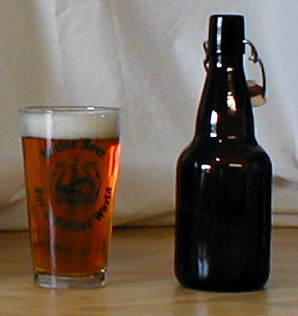
Are You Thirsty Yet?
A strong, clean pale ale with a unique hint of blackberry flavor and a light floral hop aroma
Ingredients for 5 gals:
7 1/2 lb. Organic pale barley malt extract
1/2 lb. Briess Caramel 60 oL
1/4 lb. Briess Caramel 20 oL
1/4 lb. Weyermann Carahell malt
3/4 oz Organic New Zealand Pacific Gem hop pellets- bittering (42 IBU)
1 oz American Cascade hops- flavor (12 IBU)
1 oz Organic New Zealand Hallertaur hops- aroma
OPTIONAL: 1 oz. Organic New Zealand Hallertaur hops- dry hop in secondary fermenter
Ale Yeast: Wyeast #1968 Special London Ale or White Labs #023 Burton Ale
For bottling: 8 oz. (1 1/4 cups) Dry Malt Extract (DME)*
Optional ingredients: 1/2 teaspoon Irish Moss
International Bittering Units (IBU’s): 54
Original Gravity (O.G.): 1.058- 1.062
Final Gravity (F.G.): 1.010-1.016
Approximate alcohol content: 6.5%
*If you prefer, you may use 1 cup of organic malt extract or 3/4 cup corn sugar (not included in this kit), or kraeusen with 1 quart of unfermented organic beer (see brewing tip: Kraeusening your beer) for bottling.
Instructions for Brewing:
1. Soak the grains in hot water for 15 to 20 minutes. For best results, do not boil, and do not exceed 180 oF.
2. Strain the grains (or remove grain bag) and add the grain “tea” to your brew kettle along with up to 5 1/4 gallons of water.
3. Heat the water to boiling and then turn the heat off. Add the malt extract and dissolve the extract completely. Turn the heat back on and bring to a boil.
4. Once the wort has reached a rolling boil add 3/4 oz. NZ Pacific Gem hop pellets (bittering) and boil for 40 minutes.
5. Add 1 oz. American Cascade hop pellets (flavor). If desired, add the Irish Moss flakes. Boil for 15 minutes more.
6. Add 1/2 oz. NZ Hallertaur hops (aroma), boil 5 more minutes, & turn the heat off.
7. Cool the wort to 65- 75 oF.
8. Transfer the chilled wort into your sanitized primary fermenting vessel.
9. Shake or stir (with a sanitized spoon!) the unfermented beer vigorously to add oxygen.
10. Add the yeast and ferment in a cool dark place for 4-7 days at 60- 70 oF in the primary fermenter.
11. If you have a secondary fermenter, transfer the beer to it when fermentation activity has subsided (after 4-7 days). If desired, add 1 oz. New Zealand Hallertaur hops to the secondary fermenter for dry hopping.
12. Ferment for an additional 7- 14 days, or until fermentation is complete.
13. Clean and sanitize enough bottles for your batch.
14. Sanitize your bottle caps.
15. Boil your bottling sugar in 2- 4 cups of water for 15 minutes.
16. Cool the sugar solution to 70 oF and pour into a sanitized carboy or bottling bucket. Transfer your beer into the same container and mix slowly. You can also pour the sugar solution into the same fermenter with the beer instead of transferring.
17. Use a racking cane and siphon tubing with a bottle filling tip attached to fill your bottles. Cap immediately after filling the bottles to prevent contamination.
18. Store the beer at room temperature (about 70 oF) for the first few days, then in a cool dark place
(55- 65 oF) for 1-3 weeks. Your beer is ready to drink when it is clear and nicely carbonated.
[New Post] Seven Bridges: Bringing Organic Old World Knowledge To Home Brewers – via #twitoaster http://www.theorganicview.com/featured-g…
Seven Bridges: Bringing Organic Old World Knowledge To Home Brewers http://www.theorganicview.com/featured-g… via @en RT @TheOrganicView
RT @TheOrganicView: Seven Bridges: Bringing Organic Old World Knowledge To Home Brewers http://www.theorganicview.com/featured-g… via @en RT @TheOrganicView